Sales estimate accuracy has improved, and labor hours have been reduced in the assembly process.
Automobile
Housing equipment
Medical
Mold
OA equipment
Plastic mold
Plastic molding
Assembly orders
Data conversion
Production control
Prototype
Sales quotation
Spark machining
Number of Installations:
3DTascalX15
KOGANEI MOLD CORPORATION.
Koganei Mold Co., Ltd., headquartered in Saku City, Nagano Prefecture, was founded in January 1978 as Kashiyama Mold Industry Co., Ltd. The company specializes in precision resin molds, as well as press molds and parts processing, and since becoming a group company of Koganei Corporation in 2016, it has also become a parts manufacturer that handles mass production molding.
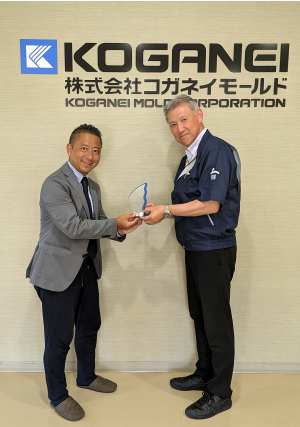
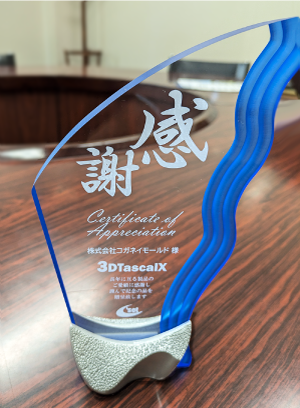
Currently, C-Set is presenting commemorative gifts to customers who have supported our products for many years as a token of our appreciation, and conducting interviews to learn about the background to their adoption and how they are being used. For the seventh installment, we visited Koganei Mold Co., Ltd. Today, we spoke with Kazuo Maruyama, Executive Officer and Head of Sales.
Kazuo Maruyama
Please tell us about your company's features.
Our company has been using high-precision processing machines for about 30 years, and has been designing all of our parts in 3D for the past 20 years. I believe this was a relatively early investment in our industry. Thanks to this, we do business with a wide variety of customers, including those in the automotive, medical, office equipment, and housing industries. Currently, the entire group is conscious of shifting from selling products to selling services, and by being able to undertake mass production molding, I feel that we are expanding the range of solutions we can provide to our customers.
How did you find out about our products?
When we were considering a 3D viewer internally, we looked at a variety of products. I remember this was one of them.
What problems did you face before the implementation?
At the time, the sales department couldn't view the 3D data provided by our business partners. We had to request the design department to create drawings and materials each time, which put a stop to the design process. Even after designing in 3D, 2D drawings were distributed to the manufacturing process, which caused inconvenience with detailed manufacturing and assembly instructions. I remember this being inefficient from a production management perspective as well.
Commemorative gift presentation
What made you decide to buy it?
First, when we were considering 3D viewers, we noticed "3DTascalX," which displays models with absolute accuracy, even though many products display them with relative accuracy. At the time, our company's CAD software was Unigraphics (now NX), so we were also interested in the fact that it used the same Parasolid kernel as the CAD software, which would ensure data compatibility.
In addition, our sales department received data such as IGES and STEP from our business partners, and we needed to be able to read this data. Furthermore, we anticipated using it in the inspection process, so dimensional accuracy was also an important point.
After considering all of these factors, we chose "3DTascalX."
What features do you use? And what are the results?
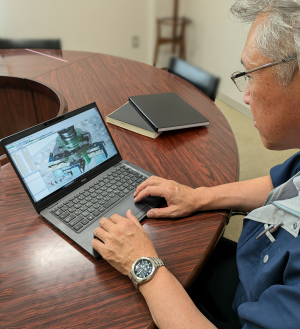
First, in the production management department, we measure the maximum outer dimensions of target parts and use them to procure steel materials. In the EDM process, we use it to set the relative positions of the workpiece and electrode, as well as the machining conditions. The assembly process is much easier to understand in 3D. It's particularly useful for understanding the product and identifying polishing areas. In the inspection process, we often use it to measure areas other than those specified on the drawing. In design, we sometimes use "3DTascalX" as a translator, converting data that doesn't load properly in CAD and then reloading it. Occasionally, we convert our own design data into 3DX and have our clients view it using the free "3DXReader." In the sales department, we review product data and create estimates.
It's honestly difficult to quantify the benefits, but the biggest one is that we can now do things that weren't possible before in each process. In sales, estimate accuracy has improved, and in the assembly process, it has led to a reduction in labor hours. This is something that's difficult to judge from a 2D drawing.
Over the past 20 years, have you considered using other viewers or software?
I had never thought about it (lol). The data conversion accuracy is good, and since we use Parasolid data internally, compatibility goes without saying. There was a time when I felt that handling assembly data was slow, but that has now been resolved. I have no complaints while using it, so there has never been a discussion about changing it.
Future Plans
I think services and software based on concepts like drawing management would also be interesting. I imagine that the range of uses would be expanded if various data could be associated with 3D data and shared among multiple people. For example, comments such as processing instructions conveyed from the previous process to the next process. It would also be even more interesting if these could be accumulated as knowledge.